EnerVenue Raises $300M for Metal-Hydrogen Grid Storage
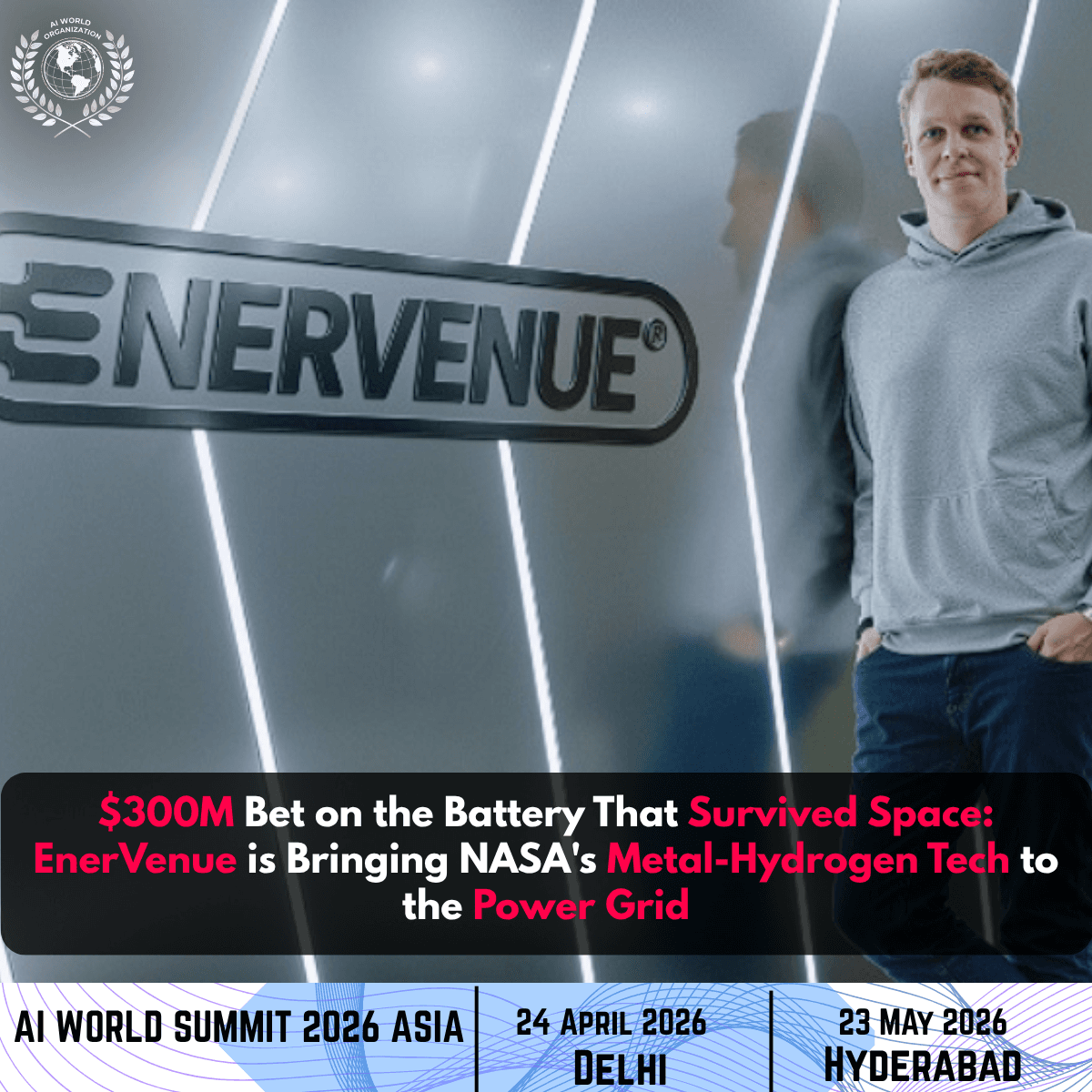
EnerVenue secures $300M Series B led by Full Vision Capital to scale metal-hydrogen battery manufacturing for grid storage and AI data centres globally.
TL;DR
EnerVenue has raised $300 million in a Series B extension, led by Full Vision Capital, to scale its NASA-derived metal-hydrogen battery technology for grid storage. With new CEO Henning Rath on board, the company is ramping up manufacturing in Changzhou toward 1 GWh capacity while targeting utility and industrial customers across Asia Pacific, the Middle East, and Europe.
EnerVenue Closes $300M Series B Extension to Scale Metal-Hydrogen Battery Manufacturing for Grid Storage and AI Data Centers
The global clean energy storage race just witnessed one of its most significant moments of 2026. EnerVenue, a California-based energy storage company that has been quietly redefining what batteries can do at the grid scale, has officially closed a $300 million extension of its Series B preferred stock financing. The round was led by Full Vision Capital, with an additional new strategic investor brought into the mix, signalling a powerful wave of institutional confidence in non-lithium battery technology. For followers of AI funding news and energy tech investment, this deal is a landmark moment — one that connects the future of renewable energy, heavy-industry decarbonisation, and the surging power demands of artificial intelligence infrastructure.
This is not just a company securing capital. This is a fundamental shift in how the energy storage market is being reimagined. EnerVenue is no longer a promising deep-tech startup; it is rapidly transitioning into a high-volume industrial manufacturing leader, and this $300 million injection is the rocket fuel behind that transformation. With fresh leadership at the helm, a clear manufacturing roadmap in place, and a global expansion strategy targeting three of the world's fastest-growing energy markets, EnerVenue's story is one of the most compelling in the AI funding and clean technology landscape today.
A New CEO and a Bolder Vision
Alongside the funding announcement, EnerVenue made a strategic leadership move that signals the next chapter of its growth. The company has appointed Henning Rath as its new Chief Executive Officer. Rath is an internationally recognised technology executive with a strong track record of building billion-dollar companies and a deep understanding of the global energy sector. He previously served as Chief Supply Chain Officer at Enpal, a leading German solar energy company, bringing with him an institutional understanding of what it takes to scale clean energy businesses across global markets.
Rath's appointment is far more than a routine C-suite change. It reflects EnerVenue's intent to pivot from pure technology development into industrial-scale commercial execution. Under his leadership, the company is placing its bets on two key pillars: ramping up manufacturing capacity in Changzhou, China, and continuing cutting-edge research and development out of its Silicon Valley base in California. The CEO has been unequivocal about the ambition this new capital unlocks. "This $300 million extension of Series B preferred stock funding is a testament to the strength of EnerVenue's technology and the entire team's execution," Rath said. "This capital provides the foundation to invest decisively in our technology roadmap, secure the supply chain for gigawatt-scale production, and build a robust global customer footprint. Our short and mid-term capacity targets of 250 MWh and 1 GWh are now fully funded."
For those tracking AI funding news, this level of conviction from leadership — backed by nine-figure capital — reflects just how seriously the investment community is taking the intersection of energy storage and AI infrastructure. As AI data centres continue to demand unprecedented amounts of reliable, around-the-clock power, the conversation around energy storage is no longer peripheral to the tech industry. It is central to it.
The Technology That Has Been to Space and Back
At the core of EnerVenue's proposition is a technology that is as fascinating as it is practical. The company's energy storage systems are built on aqueous, non-lithium, water-based metal-hydrogen cells — a battery chemistry that was originally developed and deployed by NASA for powering spacecraft and satellites in outer space. The technology was later refined and adapted for terrestrial commercial use by Dr. Yi Cui, a Stanford University professor who founded EnerVenue in 2020.
What makes this technology so distinctive — and so commercially compelling — is the combination of attributes it brings to the table. EnerVenue's Energy Storage Vessels are capable of more than 30,000 charge-discharge cycles and are designed to last up to 30 years in the field, making them three to five times more durable than conventional lithium-ion battery systems. They can cycle two to three times a day without degradation and support discharge rates ranging from 2 to 12 hours, offering flexibility for a wide range of grid-scale applications. Crucially, because the technology uses a water-based electrolyte rather than flammable organic solvents, there is no risk of thermal runaway — the dangerous overheating failure mode that has plagued lithium-ion batteries in large-scale deployments.
The research team has also made significant strides in improving the commercial viability of the technology. One of the key breakthroughs involved enhancing the battery's catalytic activity for hydrogen reactions without requiring dual catalysts — a meaningful cost-reduction achievement. The team also replaced the original NASA-grade zirconium oxide separator with a more commercially scalable and cost-effective porous polyolefin material. Even the pressure vessels that contain the cells evolved from stainless steel to lightweight composite materials, substantially reducing manufacturing costs while maintaining the structural integrity required for long-term use. These are the kinds of material science advances that separate laboratory-stage technologies from commercially scalable ones — and EnerVenue appears to have crossed that threshold.
This technology serves an increasingly urgent market need. Utilities, commercial operators, and industrial customers around the world are searching for energy storage solutions that do not just perform well on day one, but maintain consistent, reliable performance over decades — without the fire risks, the degradation curves, or the replacement cycles that have historically been associated with lithium-based systems. EnerVenue's metal-hydrogen cells are explicitly designed to behave like grid infrastructure: durable, predictable, and long-lived.
Changzhou Manufacturing Scale-Up and the Global Expansion Blueprint
The $300 million in new AI funding news will be deployed with a clear geographic and operational strategy. EnerVenue's primary manufacturing hub is its production facility in Changzhou, Jiangsu province, China — a city widely regarded as one of the world's premier centres of battery manufacturing expertise. The decision to anchor manufacturing in Changzhou is a deliberate one, designed to allow EnerVenue to optimise its cost structure, tap into a deep pool of supply chain partners, specialised engineering talent, and battery production know-how that simply does not exist at this scale anywhere else in the world.
The immediate target is to build out a 250 MWh annual production line at the Changzhou facility — a Phase 1 target that is, according to the company's leadership, now fully funded with this round. From there, the roadmap scales to 1 GWh of annual production capacity, with longer-term ambitions pointing toward gigawatt-scale output as global demand for grid-scale storage accelerates. To place that in context, a gigawatt-hour of storage capacity is enough to power hundreds of thousands of homes for extended periods, or to support the 24/7 baseload power requirements of multiple large AI data centres.
While manufacturing scales up in China, EnerVenue is committed to keeping its R&D function firmly rooted in Silicon Valley. This dual-geography model — manufacturing excellence in Asia, innovation leadership in California — is a structure that many of the world's most successful hardware and deep-tech companies have used to build global competitive advantage. For EnerVenue, it means that advances in next-generation aqueous metal cell technology will continue to feed into the manufacturing pipeline, ensuring that the company's products remain ahead of the market curve even as it scales.
Commercially, the company is targeting three major international markets in the near term: the Asia Pacific region, the Middle East, and Europe. These are not arbitrary choices. Asia Pacific is home to some of the world's fastest-growing electricity markets and rapidly expanding renewable energy deployments. The Middle East, anchored by strategic investor Aramco Ventures, represents both a massive energy infrastructure modernisation opportunity and a gateway to sovereign wealth-backed energy projects. Europe, driven by its aggressive renewable energy transition targets and the phase-out of fossil fuel power, is one of the world's most demanding markets for grid-scale storage solutions. EnerVenue's commercial playbook in these regions will focus on utilities, large commercial operators, and industrial customers who require reliable, long-duration storage at scale.
Competing in the Long-Duration Storage Race
The competitive landscape in which EnerVenue is operating is both dynamic and diverse. The company's primary rivals in the grid-storage space are not the lithium-ion giants like Tesla, Fluence, or Enphase — those companies dominate the short-duration storage segment. EnerVenue is competing in the long-duration, non-lithium storage category, where the key players include Form Energy with its iron-air battery technology, ESS Inc. and Invinity with their flow battery systems, and a handful of other advanced nickel-hydrogen and alternative chemistry providers.
What differentiates EnerVenue in this competitive field is the combination of NASA-heritage reliability, decades of Stanford research refinement, and the specific performance characteristics of its metal-hydrogen chemistry. While iron-air batteries like Form Energy's offer compelling cost economics, they are still in earlier stages of commercial deployment. Flow batteries from ESS Inc. and Invinity offer longevity but come with complexity in the balance-of-plant equipment they require. EnerVenue's approach — a cell-level technology that is inherently simple, inherently safe, and inherently durable — offers a differentiated value proposition for customers who prioritise operational reliability and total cost of ownership over the lifetime of an asset.
The growing relevance of AI data centres to this competitive picture cannot be overstated. As AI funding news has consistently highlighted over the past two years, the computing infrastructure that powers large language models, autonomous systems, and AI-driven applications consumes electricity at a scale that is straining grid infrastructure globally. Data centres are increasingly demanding not just grid connections, but firm, dispatchable storage capacity that can guarantee uninterrupted power supply. EnerVenue's 30-year, 30,000-cycle storage systems are precisely the kind of infrastructure-grade technology that hyperscale data centre operators and colocation providers are beginning to evaluate seriously. EnerVenue's CEO has acknowledged that AI data centres represent one of the most important future growth directions for the company — a signal that the company is well aware of how the energy and AI sectors are converging.
The backing of Aramco Ventures as a strategic shareholder adds another important dimension to EnerVenue's competitive position. Aramco's involvement is not merely financial — it opens doors to large-scale energy projects across the Gulf Cooperation Council countries, where massive grid modernisation programmes and renewable energy buildouts are underway as part of national economic diversification strategies. These are exactly the kinds of long-duration, utility-scale storage deployments where EnerVenue's technology shines.
Why This Round Matters Beyond the Numbers
It is easy to look at a $300 million AI funding round and reduce it to a headline figure — but the deeper significance of this investment round lies in what it represents for the broader trajectory of the clean energy and technology sectors. The world is at an inflection point in energy storage. Lithium-ion has been the dominant chemistry for the past decade, but its limitations — cost, safety, cycle life, and raw material supply chain concentration — are increasingly apparent at the grid scale. The search for alternatives that can match lithium's cost economics while surpassing its performance and safety limitations is one of the defining technology challenges of the 2020s.
EnerVenue's $300 million Series B extension is one of the largest single capital commitments to a non-lithium energy storage company in recent AI funding news, and it sends a clear message to the market: the era of lithium dominance in grid-scale storage is not permanent. Investors with the technical sophistication and the time horizon to evaluate long-duration storage technologies are beginning to place significant bets on alternatives — and EnerVenue, with its NASA-heritage technology, Stanford research lineage, and now a fully funded manufacturing scale-up, is among the most credibly positioned to deliver on that promise.
The appointment of Henning Rath as CEO also reflects a maturation in how the company is thinking about itself. EnerVenue is no longer positioning itself as a technology innovator seeking to prove a concept. It is positioning itself as an industrial company seeking to win market share at scale — and that is a very different, and much more commercially serious, ambition. The combination of a seasoned operations executive at the top, a fully funded manufacturing roadmap, a globally diversified commercial strategy, and strategic backing from energy industry heavyweight Aramco Ventures gives EnerVenue perhaps its best shot yet at achieving the kind of scale that can genuinely reshape the grid-scale storage market.
From an AI funding perspective, this deal is also a reminder that the most significant infrastructure investments underpinning the AI revolution are not always the headline-grabbing model training rounds or chipmaker valuations. The quiet, less visible infrastructure that keeps the lights on at AI data centres — reliable, long-duration, grid-scale storage — is increasingly where sophisticated capital is flowing. EnerVenue's $300 million round is a piece of that broader puzzle, and its implications for how AI infrastructure is powered over the next decade are substantial.